Nathan Gombet’s first confrontation with Nancy Drew
The Hidden StaircaseNathan Gombet’s first confrontation with Nancy Drew turns a demand for papers into a direct intrusion into the Drew home. Gombet claims that Carson Drew possesses documents connected to his river property rights; when Nancy refuses to hand them over, he searches Carson’s desk himself. Her resistance establishes the personal conflict between them and gives the later mystery a concrete beginning: a land dispute becomes a pretext for pressure, intrusion, and ultimately a wider criminal scheme.
The Uninvited Visitor
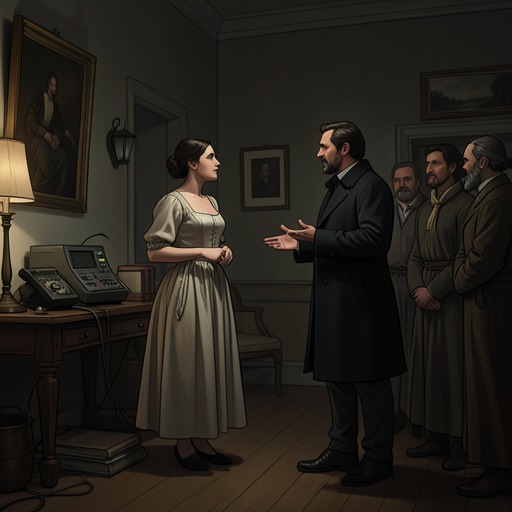
Nancy encounters Gombet at the door while Carson is away. He does not wait for an invitation before entering, and his abruptness immediately sets the terms of the meeting: he treats the house not as private space but as somewhere he can enter and make demands. Nancy has only an instant to assess him before he is inside. His shabby, outdated clothing and unpleasant appearance contribute to her first impression, but his conduct soon matters more than his appearance.
Gombet insists that he must see Carson at once, despite Nancy’s explanation that her father is out of town. He will not leave a message. Instead, he asks whether Carson has left papers for him and identifies the subject as his property rights on the river, accusing Carson and his associates of having dealt unfairly with him. Nancy says that she does not know which papers he means. The exchange therefore discloses both the demand and its limits: Gombet names a grievance, but offers no reason for Nancy to act as his agent or to surrender anything in her father’s possession.
The Search of Carson’s Desk
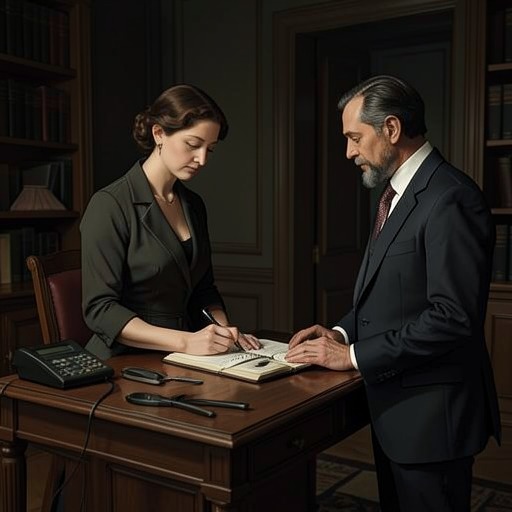
Nancy knows that Carson sometimes keeps valuable papers in his desk, but has never heard him discuss the documents Gombet wants. She does not intend to turn over any papers and believes Gombet is trying to obtain something that does not belong to him. Though frightened by his strange behavior, she tells him to leave. He responds by announcing that he will look around for himself, then moves toward the adjoining study, where Carson’s desk is visible.
Gombet’s rapid move from accusation to unauthorized search changes the confrontation from a dispute conducted in words to an invasion of the family’s private space. He crosses the room, opens a desk drawer, and rummages through it. Nancy grasps his coat and pulls him away, ordering him out and threatening to call the police. The effort does not end the encounter peacefully: Gombet frees himself with a forceful jerk and turns on her in anger. The scene reaches the threshold of physical violence, with Nancy raising her hands to protect herself, but the available account does not establish that he strikes her. What it does establish is that his pursuit of the papers overrides any restraint once Nancy refuses him access.
The Disputed Property Claim
Carson later explains the history behind Gombet’s accusation. Gombet’s land had been condemned for a railroad right of way, and Carson, serving on the land commission, says he saw to it that Gombet was well paid. According to Carson, Gombet initially seemed satisfied, then sought additional compensation after a bridge was built, arguing that it had damaged the rest of his property. Carson considered those later claims unreasonable. This account supplies the dispute’s background, while Gombet’s own later demand makes the disagreement more specific: he says the land was worth several times what he received and wants either the deed back or the price he believes it was worth.
The competing accounts distinguish a property grievance from the methods Gombet uses to pursue it. He may describe himself as cheated, but his first encounter with Nancy shows him trying to obtain documents by entering a home uninvited and searching a desk after being told no. Carson also recalls hearing that Gombet had made threats about blowing up the bridge, a report serious enough to make him say he should keep an eye on Gombet. The book thus connects the domestic intrusion to a continuing conflict over compensation without treating Gombet’s allegations as proof that his conduct is justified.
From Intrusion to Criminal Coercion
The later course of events gives the first confrontation its larger significance. Gombet’s interest in Carson’s papers anticipates his later efforts to force Carson to transfer money and promise not to prosecute him. When Carson describes his captivity, he says Gombet tricked him into coming to the old stone house in Cliffwood and held him there for several days while trying to make him sign over money. The agreement found there calls for a large payment and a promise not to prosecute. These later facts make the initial search more than an isolated act of rudeness: it is an early instance of Gombet seeking leverage through pressure on Carson and his family.
Gombet’s house and its servant also connect the first visit to the later investigation. When Carson is brought to the house, the servant quietly locks the outside door after the two men pass through the kitchen. Nancy later sees her washing dishes at the kitchen sink while preparing to enter the house, and hears her searching the cellar after suspecting a sound. During the police approach, the servant is found holding a sawed-off shotgun at the kitchen door. These episodes establish her participation in the operation, though they occur after the confrontation at the Drew home and should not be confused with the first encounter itself.
Nancy’s Resistance and the Event’s Role
Nancy’s response is the decisive counterforce in the scene. She does not know the details of the land dispute, yet she refuses to hand Gombet papers, challenges his entry into the study, and physically pulls him away from Carson’s desk. Her threat to call the police marks a boundary he has already crossed; his attempt to continue searching turns her suspicion into active resistance. The confrontation therefore introduces Nancy not merely as the person Gombet approaches, but as someone who will obstruct his access to the evidence and property he seeks.
The event also plants the conflict’s central contrast: Gombet invokes rights and alleged unfair payment, while acting through trespass, intimidation, and later coercion. Carson’s account of the railroad compensation clarifies the grievance, and the subsequent evidence of forced payment reveals how far Gombet’s methods extend beyond that dispute. The first encounter brings those strands together at the desk: the papers represent the claim he wants to press, while Nancy’s refusal begins the opposition that will expose his conduct.